
Social media marketers and business owners live by data, but two of the most fundamental performance indicators still cause widespread confusion. When a marketing campaign wraps and you sit down to evaluate the numbers, knowing whether to focus on reach vs impressions and what each data point actually communicates is the difference between vanity tracking and real, strategic insight.
Misreading these two numbers can cause you to optimize your content for the wrong outcomes entirely. Both metrics track visibility, but they analyze your content’s performance from two completely different angles.
To help you get the most out of your digital marketing metrics, let’s break down exactly what these terms mean, how they vary across platforms like Instagram and LinkedIn, and how to use them to refine your content distribution.
What is Reach?
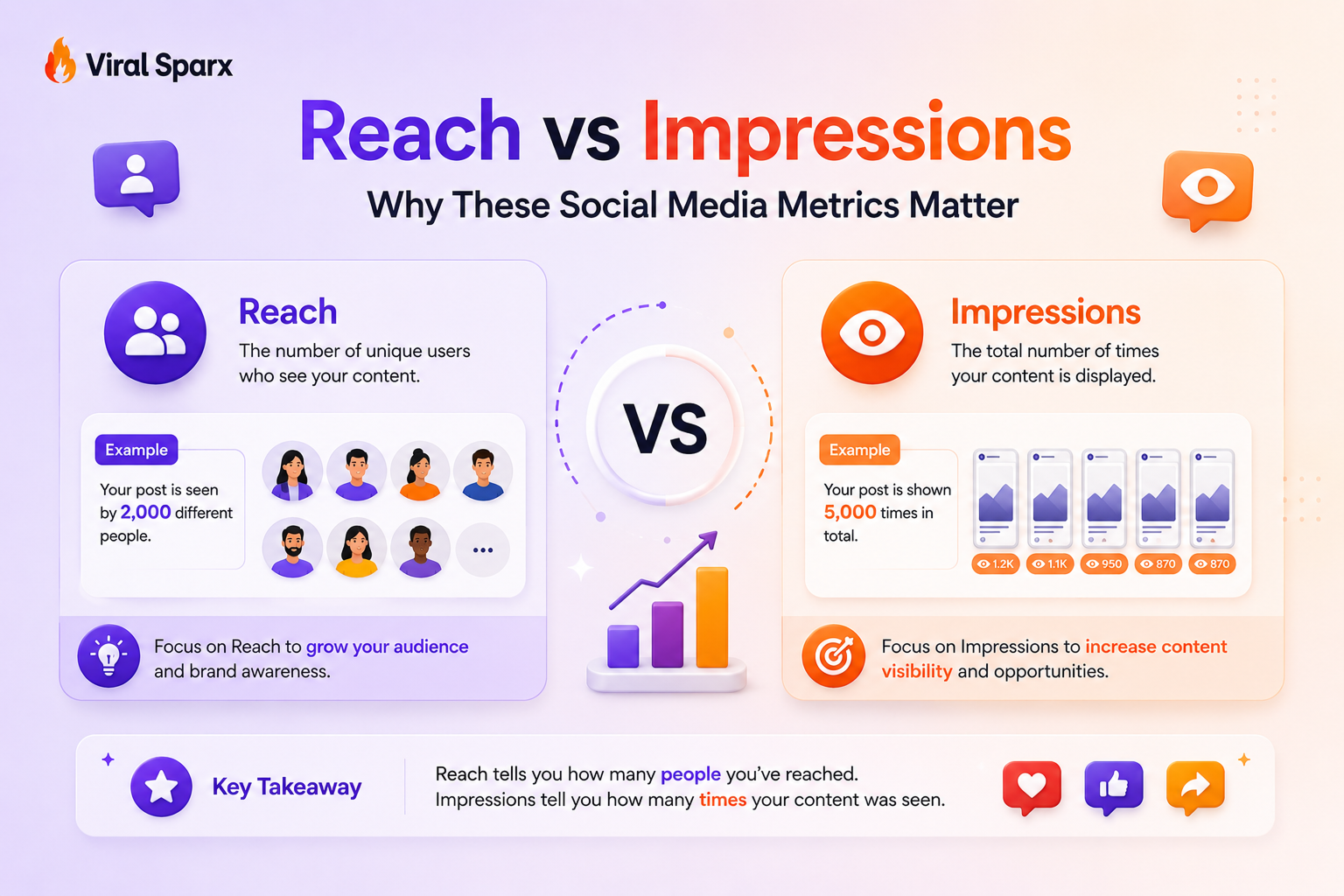
Reach measures the total number of unique users who have seen your content at least once during a specific timeframe.
Think of reach as your audience size or the unique accounts that encountered your post. If your content appears on a user’s screen, they count as one “account reached.” If that same person logs in later and looks at the exact same post again, your reach number does not change. It remains at one.
When you are focused on building brand awareness or trying to expand your audience exposure, tracking your social media reach tells you exactly how far your message traveled across the digital landscape.
What are Impressions?
Impressions measure the total number of times your content was displayed on a screen, regardless of whether it was clicked or who saw it.
Unlike Reach, Impressions count every single view and repeat exposure. If one person scrolls past your post in the morning, sees it again when a friend shares it in the afternoon, and views it a third time in the evening, that single user contributes three to the total impressions count.
Impressions help you understand content visibility and delivery frequency. A high number of impressions relative to your unique audience size shows that your content is resurfacing multiple times in front of the same group of people.
The Core Difference: Reach vs Impressions Examples
The easiest way to understand the difference between impressions vs reach is through a simple real-world scenario. Imagine you publish a post on your business profile.
- Ten unique people open their apps and see your post on their feeds.
- Five of those people find the content interesting, so they revisit your profile later to look at the post a second time.
In this scenario:
- Your reach is 10 (the number of unique users exposed to the content).
- Your impressions are 15 (10 initial views + 5 repeat views).
Because a single person can view content multiple times, your total impressions will almost always be equal to or higher than your reach. It is mathematically impossible for unique reach to exceed total impressions.
Why Do Impressions Outpace Reach?
If you check your analytics dashboard and notice that your impressions count is double or triple your unique audience reach, don’t panic. This is standard behavior across almost every social media algorithm.
Impressions outpace reach because of content distribution and user behavior. A high impression-to-reach ratio means your content has good feed visibility. It signals that users are returning to your post, or the platform’s distribution engine is serving your content to the same highly interested users multiple times.
While this is excellent for message reinforcement, if your impressions climb drastically while unique discovery stays completely flat, it could eventually lead to audience fatigue if the content isn’t refreshed.
Reach vs Views vs Engagement: How They Intersect
To truly judge content performance metrics, you cannot look at visibility numbers in isolation. You need to understand how exposure connects with actions. This is where engagement vs reach and engagement vs impressions come into play.
- Reach and Impressions tell you how many eyes were potentially on your content.
- Views generally refer to video plays (often counted after a user watches for a specific number of seconds, depending on the platform).
- Engagement measures tangible actions: likes, comments, shares, saves, and link clicks.
By looking at these metrics together, you can run a quick diagnostic on your overall social media content strategy guide.
For instance, if a post has an incredibly high unique reach but almost zero interactions, it indicates a disconnect. Your content visibility is great, but the message itself isn’t resonating with the audience, or you are reaching the wrong demographic. Conversely, if your reach is modest but your engagement rate is sky-high, it means your current audience loves what you are doing you just need to adjust your social media marketing strategy guide to scale your content distribution to new eyes.
Platform-Specific Metrics: Tracking Across Major Networks
Every major social network handles data tracking slightly differently. Knowing the native terminology prevents you from misinterpreting your data. when compiling cross-platform reports.
Instagram Reach vs Impressions
Inside the Instagram Professional Dashboard, you will find metrics labeled as Accounts Reached and Views. Accounts reached reflects your unique users, while views track the total delivery count. If you are looking to scale your profile, keeping an eye on these is crucial. To get a holistic view of your performance, pair these metrics with actionable steps from our social media management tips to streamline your review process.
Facebook Reach vs Impressions
Managed through Meta Business Suite, Facebook explicitly separates organic reach, paid reach, and viral reach from total impressions. Meta notes that unique reach metrics are often statistical estimates rather than exact real-time tallies, so treat these numbers as directional trends for your campaign performance.
LinkedIn Reach vs Impressions
LinkedIn analytics displays these metrics as Impressions and Unique Impressions. If you run B2B campaigns, monitoring unique impressions tells you how many individual professionals have been exposed to your brand, which is a major KPI for authority building.
TikTok Reach vs Impressions
TikTok analytics measures exposure through Video Views (impressions) and Reached Audience (reach). Because the TikTok algorithm prioritizes content discovery via the “For You” page, your reached audience numbers can spike dramatically if a video catches a viral wave.
YouTube Reach vs Impressions
YouTube Studio handles these metrics with distinct nuances. Impressions only count when a video thumbnail is shown to someone for more than one second on YouTube. Unique Viewers represent your actual reach. To see how these numbers stack up against industry standards, explore the latest youtube statistics to benchmark your channel’s visibility.
When to Prioritize: Reach vs Impressions
Neither metric is universally “better” than the other. The metric you choose to prioritize depends entirely on your current business goals and your overarching social media plan guide.
Prioritize Reach When: | Prioritize Impressions When: |
| Launching a new product or service | Promoting a time-bound sale or local event |
| Maximizing brand awareness | Reinforcing a specific brand message or slogan |
| Targeting new audiences | Increasing the frequency of ad exposure |
| Growing and diversifying your community | Staying top-of-mind with existing audiences |
When to Prioritize Reach
Prioritize unique reach when your primary target is top-of-funnel brand awareness. If you are launching a new product, breaking into a new geographic market, or trying to attract new members to build a powerful brand community, success means getting your content in front of as many individual, unique people as possible.
When to Prioritize Impressions
Prioritize total impressions when your goal is message reinforcement and conversion. In digital marketing, a consumer rarely buys a product the first time they see it. High frequency meaning a single user sees your message multiple times builds familiarity. If you are running a limited-time promotion, tracking impressions ensures your audience is exposed to the offer frequently enough to take action.
How to Improve Your Visibility Metrics
If your social media analytics dashboard shows stagnant growth, you need to adjust your approach to content distribution.
To Increase Your Reach:
- Tap into Virality: Study current media patterns. Use resources like our trending instagram audio guide find viral reel sounds in 2026 to leverage algorithmic boosts that push your content to non-followers.
- Build Dedicated Groups: Participate in niche spaces. Engaging with platforms through strategic hubs like our twittter communities guide allows you to drop content directly in front of highly targeted, unique groups of users.
- Optimize Discovery: Format your profiles clearly. Using optimization frameworks such as our instagram bio for business examples and tips ensures that when new users do find your content, they immediately convert into profile followers.
To Increase Your Impressions:
- Focus on Platform Diversity: Share content on platforms built for long-term discovery. Implementing strategies from our guide on how to use pinterest for business growth in 2026 helps you generate consistent, long-tail impressions months after a post goes live.
- Improve Content Shareability: Create highly educational assets, step-by-step guides, or highly relatable industry graphics. When users save your posts or share them to their personal feeds, it triggers repeat impressions across overlapping networks.
Mastering Your Marketing Analytics
At the end of the day, understanding reach vs impressions isn’t just about learning marketing terminology it’s about making smarter strategic decisions. By recognizing whether you are expanding your community or deepening your connection with your existing audience, you can match your creative output directly to your business KPIs.
If managing these shifting numbers across multiple channels feels overwhelming, team up with an expert partner. At ViralSparx, we specialize in taking the guesswork out of your digital marketing. From refining your overall top social media branding strategies to decoding your performance tracking dashboards, we provide actionable insights that translate directly into business growth. Let us help you transform raw data into a powerful, visible brand presence.
Frequently Asked Questions
Is reach more important than impressions?
Neither is inherently more important. Reach matters more for expanding brand awareness and finding new customers, while impressions matter more for message frequency, retention, and driving conversions through consistent exposure.
Can impressions be lower than reach?
No. Because reach counts unique individuals and impressions count total views (including repeat exposures), impressions will always be equal to or higher than your reach.
Does viewing your own post count as an impression?
Yes, On most social networks, loading your own profile or feed will trigger an impression for your post. However, it will not increase your unique reach count since you are logged into your own account.